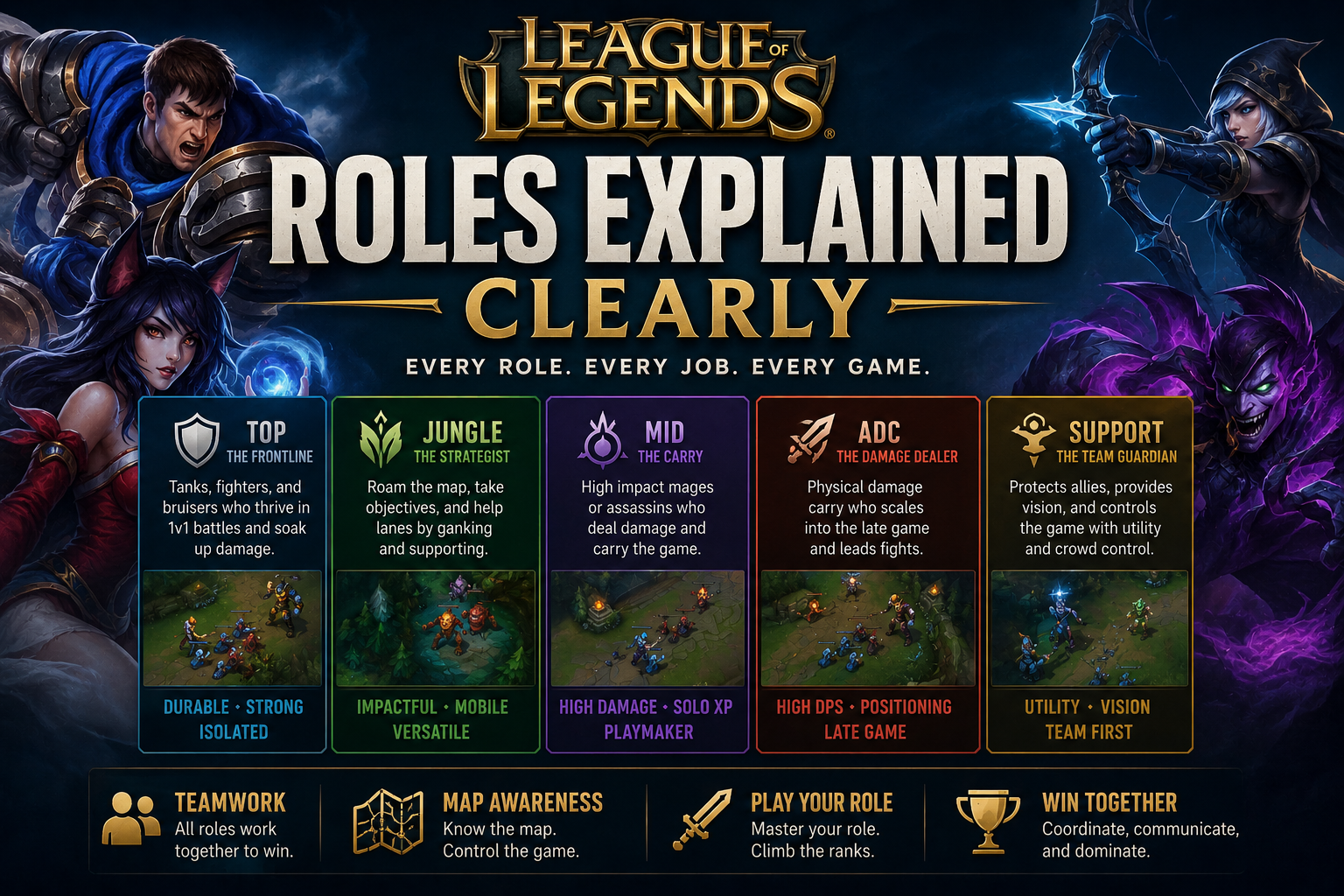
What if the biggest mistake new League of Legends players make is choosing champions before understanding the role they’re supposed to play?
One of the most confusing parts of League is that every role has:
- Different responsibilities
- Different playstyles
- Different ways to win the game
A player dominating in one role can struggle badly in another—not because they’re bad, but because the mindset changes completely.
In 2025–2026, League has become even more strategic, and understanding roles properly is one of the fastest ways to improve.
So let’s break every role down in the clearest way possible.
Understanding the Basic Team Structure
A standard League team has 5 players:
- Top Lane
- Jungle
- Mid Lane
- ADC (Bot Carry)
- Support
Each role contributes differently to:
- Damage
- Objectives
- Teamfights
- Map control
👉 League is not about individual kills alone—it’s about how roles work together.
Top Lane — The Isolated FighterWhat Top Lane Does
Top lane is usually:
- A solo lane
- More isolated from early fights
- Focused on survival and scaling
Typical Champions
- Tanks
- Bruisers
- Duelists
Examples:
- Fighters with sustain
- Durable frontline champions
Main Responsibilities
- Survive lane pressure
- Split push or frontline later
- Control side lanes
Why Top Lane Feels Unique
Top lane is often:
- Slower paced early
- Very matchup-dependent
- Punishing if mistakes happen
👉 Small mistakes can decide the entire lane.
Jungle — The Map Controller
What the Jungler Does
The jungler:
- Farms jungle camps
- Helps lanes through ganks
- Secures objectives
Main Responsibilities
- Dragon control
- Rift Herald / Baron control
- Helping teammates gain advantages
Why Jungle Is Important
The jungler influences:
- Every lane
- Objective fights
- Game tempo
👉 Good junglers control the pace of the match.
Why Jungle Is Difficult
You need:
- Map awareness
- Timing
- Decision-making
Common Beginner Mistake
Trying to gank constantly without farming properly.
Mid Lane — The Flexible Playmaker
What Mid Lane Does
Mid lane sits in the center of the map, allowing quick rotations.
Typical Champions
- Mages
- Assassins
- Burst damage dealers
Main Responsibilities
- Deal damage
- Roam to side lanes
- Help secure objectives
Why Mid Lane Is Popular
Mid laners often:
- Have high carry potential
- Influence fights quickly
- Create game-changing plays
👉 Mid lane rewards mechanics and map awareness heavily.
ADC (Attack Damage Carry) — The Late-Game Damage Dealer
What ADC Does
ADC focuses on:
- Consistent ranged damage
- Scaling into late game
- Teamfight damage output
Typical Champions
- Marksmen
- High DPS ranged carries
Main Responsibilities
- Farm safely
- Stay alive in fights
- Deal sustained damage
Why ADC Is Challenging
ADC players are:
- Very fragile
- Constantly targeted
- Positioning-dependent
👉 One positioning mistake often means instant death.
Support — The Team Enabler
What Support Does
Supports help the team instead of focusing mainly on farming.
Main Responsibilities
- Protect teammates
- Provide vision
- Start fights or peel carries
Types of Supports
Engage Supports
Start fights aggressively.
Enchanters
Heal and protect teammates.
Mage Supports
Deal poke damage and pressure lanes.
Why Support Is More Important Than People Think
A good support controls:
- Vision
- Teamfight setup
- Lane pressure
👉 Strong supports can completely carry games through decision-making.
How the Roles Work Together
League only works when roles cooperate.
Example Team Interaction
- Top lane absorbs pressure
- Jungle controls objectives
- Mid creates map pressure
- ADC provides damage
- Support enables the team
👉 Every role fills a strategic purpose.
Which Role Is Best for Beginners?
Easiest Starting Roles
Top Lane
Simpler map focus.
Support
Less farming pressure.
Harder Beginner Roles
Jungle
Requires strong game knowledge.
ADC
Punishing positioning requirements.
👉 Mid lane difficulty depends heavily on champion choice.
Which Role Has the Most Carry Potential?
This depends on skill level and game state.
High Carry Roles
Mid Lane
Strong map influence.
Jungle
Controls objectives and tempo.
ADC
Massive late-game damage.
👉 Every role can carry differently.
League Meta Trends
Modern League roles are evolving.
Current Trends
- More objective-focused gameplay
- Faster map rotations
- Flexible champion picks
- Increased importance of team coordination
👉 Understanding macro play matters more than ever.
Common Role Mistakes
Top Lane Mistakes
- Fighting constantly without reason
- Ignoring wave management
Jungle Mistakes
- Over-ganking
- Ignoring objectives
Mid Lane Mistakes
- Never roaming
- Tunnel vision on lane fights
ADC Mistakes
- Poor positioning
- Overextending alone
Support Mistakes
- Lack of vision control
- Roaming at bad times
Real-Life Example: Why Roles Matter
A mechanically skilled player may dominate Mid lane but struggle in Support because:
- The decision-making changes
- Objectives change
- Team responsibilities change
👉 Understanding the role matters more than raw mechanics alone.
Actionable Tips for Choosing Your Role
- Pick a role matching your playstyle
- Focus on learning one role first
- Master fundamentals before champion pools
- Watch role-specific gameplay
- Practice map awareness constantly
Conclusion: Roles Define How You Experience League
League of Legends becomes much easier to understand once you realize that every role serves a completely different purpose within the team. Top laners focus on pressure and durability, junglers control the map, mid laners create plays, ADCs provide sustained damage, and supports enable the entire team through vision and utility. Each role requires a unique mindset, and improving in League often starts with fully understanding the responsibilities of the position you play. Rather than trying to master everything at once, focusing on one role and learning its strengths, weaknesses, and objectives will help you improve faster and enjoy the game far more consistently.