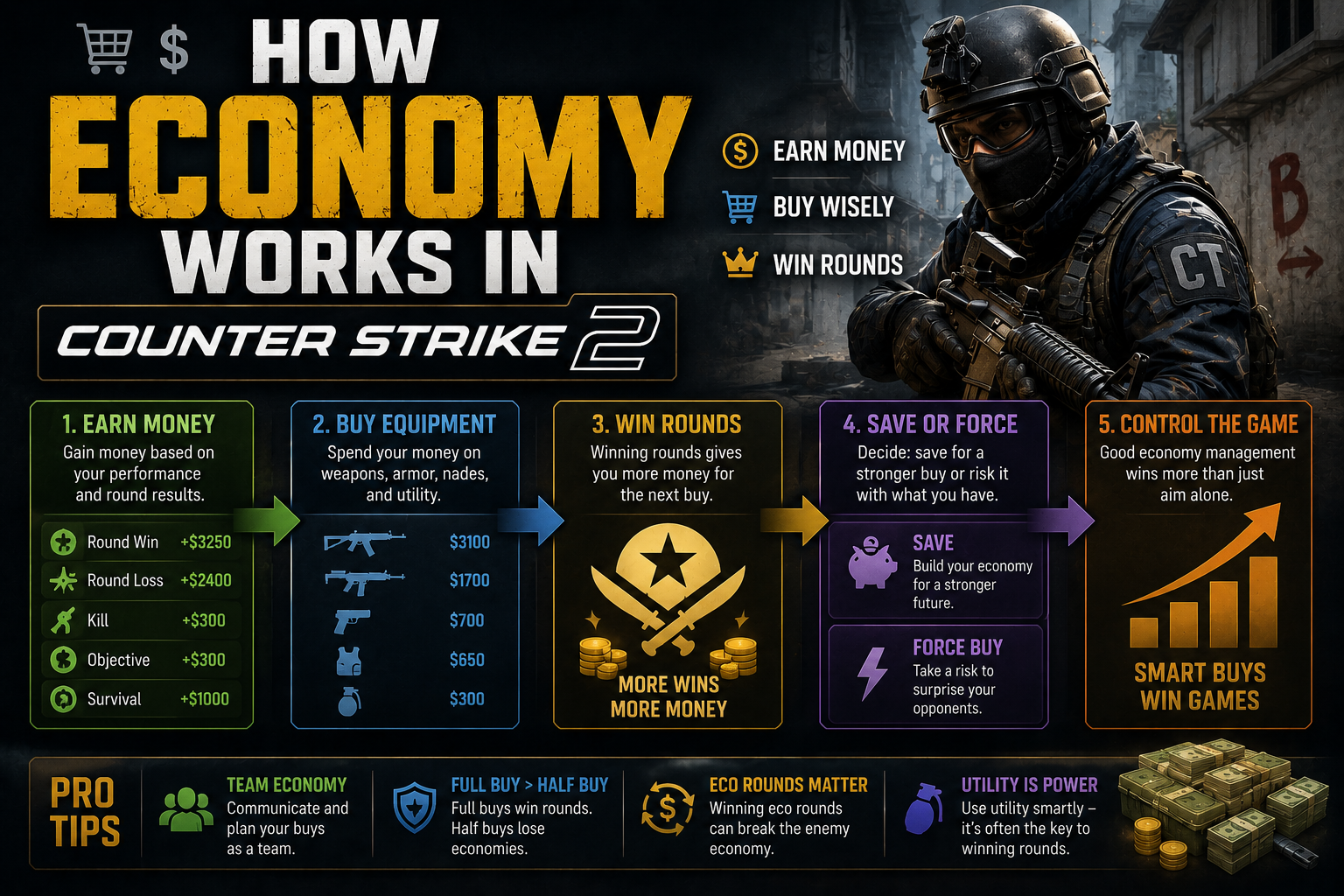
What if the most important skill in Counter-Strike 2 isn’t aim—but money management?
Many new players think CS2 is only about shooting skill. But experienced players know matches are often decided by something much deeper: the economy system.
A team with better weapons usually has a huge advantage. And the way teams earn, spend, save, and manage money directly affects:
- Weapon quality
- Utility usage
- Round-winning potential
In 2025–2026 competitive CS2, understanding economy is one of the fastest ways to improve your win rate.
What Is the Economy System in CS2?
The economy system controls how much money players have to buy:
- Weapons
- Armor
- Grenades
- Defuse kits
Every decision affects future rounds.
👉 Good economy management creates stronger future buys.
How Players Earn Money
Money is earned through different actions during rounds.
1. Winning the Round
Winning gives the biggest reward.
Approximate Rewards
- Standard round win → around $3,250 per player
- Bomb explosion (T-side) → bonus money
- Special win conditions vary slightly
👉 Winning consistently builds strong economies quickly.
2. Losing the Round (Loss Bonus)
Even losing gives money.
Why This Exists
Without loss bonuses:
- Teams would become permanently weak
- Matches would become one-sided quickly
How It Works
The more rounds you lose consecutively:
- The higher the loss bonus becomes
👉 This system helps losing teams recover.
3. Kill Rewards
Different weapons give different kill rewards.
Examples
- Rifles → lower reward
- SMGs → higher reward
- Shotguns → very high reward
Why This Matters
Weapon choice can affect long-term economy.
What Is a “Buy Round”?
A buy round is when a team spends heavily on equipment.
Typical Full Buy Includes
- Rifle
- Armor
- Full utility
- Defuse kit (CT side)
👉 Full buys maximize round-winning chances.
What Is an Eco Round?
An eco round means spending very little money.
Why Teams Eco
To save money for stronger future rounds.
Common Eco Purchases
- Pistols only
- Minimal utility
- No armor sometimes
👉 Sacrificing one round can strengthen future rounds.
What Is a Force Buy?
A force buy is when teams spend despite limited money.
Why Teams Force Buy
- Try to surprise opponents
- Prevent economy collapse
- Maintain pressure
Risk
If the force buy fails:
- Future economy becomes very weak
👉 Force buys are high-risk, high-reward decisions.
What Is a Half Buy?
A half buy is a middle-ground strategy.
Typical Half Buy
- Cheap weapons
- Light utility
- Partial armor
Why Teams Use It
Maintain some competitiveness while still saving money.
Utility Economy: Why Grenades Matter
Economy is not just about rifles.
Important Utility
- Smoke grenades
- Flashbangs
- Molotovs
- HE grenades
Why Utility Is Critical
Good utility:
- Controls map space
- Stops pushes
- Creates easier fights
👉 Teams with poor utility often lose even with good weapons.
CT Economy vs T Economy
Economy affects both sides differently.
Counter-Terrorist (CT) Economy
CT side is usually more expensive.
Why
CTs often need:
- Defuse kits
- More utility
- Expensive rifles
👉 Losing multiple CT rounds can become very damaging economically.
Terrorist (T) Economy
T side is generally cheaper.
Why
T-side strategy often relies more on:
- Entry pressure
- AK-47 buys
- Faster economy recovery
👉 T-side economies are usually easier to rebuild.
Why Saving Weapons Is Important
Sometimes teams intentionally avoid impossible fights.
Why Players Save
Keeping weapons:
- Preserves economy
- Prevents expensive rebuying next round
Common Situation
2 players alive vs 5 opponents:
👉 Saving may be smarter than fighting.
How Momentum Affects Economy
CS2 economy creates momentum swings.
Example
A team wins:
- Several rounds
- Builds money
- Buys stronger utility repeatedly
Meanwhile opponents:
- Struggle to afford rifles
- Enter weaker rounds
👉 Economy advantages snowball quickly.
The Hidden Importance of SMGs
SMGs are strong economic weapons.
Why Pros Use Them
- High kill rewards
- Strong anti-eco weapons
- Cheap compared to rifles
👉 Smart teams use SMGs strategically to farm money.
CS2 Meta Economy Trends
Modern CS2 strategy focuses heavily on economy optimization.
Current Trends
- Smarter utility spending
- Increased importance of saving
- More calculated force buys
- Better anti-eco coordination
👉 Professional teams manage money almost like a strategy game.
Common Economy Mistakes
Buying Alone
One player buying while teammates eco creates weak team rounds.
Over-Forcing
Constant force buys destroy long-term economy.
Ignoring Utility
Rifles without grenades are often ineffective.
Fighting Lost Rounds
Unnecessary deaths reduce future economy.
Real-Life Scenario: Why Economy Wins Matches
Team A:
- Buys randomly
- Has inconsistent weapons
- Lacks utility
Team B:
- Coordinates buys
- Saves properly
- Maintains strong economy cycles
👉 Team B usually wins consistently over time.
Simple Economy Rule for Beginners
Ask These Questions Every Round
- Can the whole team afford rifles next round?
- Should we save together?
- Do we need utility more than expensive weapons?
👉 Team economy matters more than individual buying.
Actionable Tips to Improve Your Economy Management
- Coordinate buys with teammates
- Learn when to eco properly
- Prioritize utility
- Save weapons when rounds are lost
- Avoid unnecessary rebuys
Conclusion: CS2 Is as Much About Money as Aim
The economy system in Counter-Strike 2 is what gives the game its deep strategic layer, turning every round into more than just a firefight. Managing money correctly affects weapon strength, utility usage, and long-term momentum, often deciding matches before players even engage in combat. Teams that understand when to buy, save, force, or eco consistently create stronger opportunities and maintain pressure throughout the game. While aim and mechanics are important, true improvement in CS2 comes from understanding how economy decisions shape every round, because the smartest teams are usually the ones that stay armed, organized, and prepared when it matters most.